A well-stocked first-aid kit is essential to ensure you are well protected when travelling. Whether you are planning a relaxing beach holiday, an adventurous backpacking trip or travelling on business – unforeseen illnesses or minor injuries can always occur. It is important to make the right preparations in advance so that you can enjoy your holiday without any worries. In this article, we present a comprehensive checklist for your first-aid kit so that you are well prepared for your next holiday.
What should definitely be in your first-aid kit?
When packing for a holiday, the question often arises as to what belongs in the first-aid kit. A well-stocked first-aid kit is essential to be prepared for minor ailments and emergencies while travelling. It is important to find a balance between carrying essential medication and avoiding clutter.
This is what your first-aid kit should contain:
Painkillers and antipyretics
Remedies for diarrhoea
Personal medication
Disinfectants and wound care
Remedies for allergies and insect bites
Sun and skin protection
Remedies against travel sickness
Tweezers and scissors
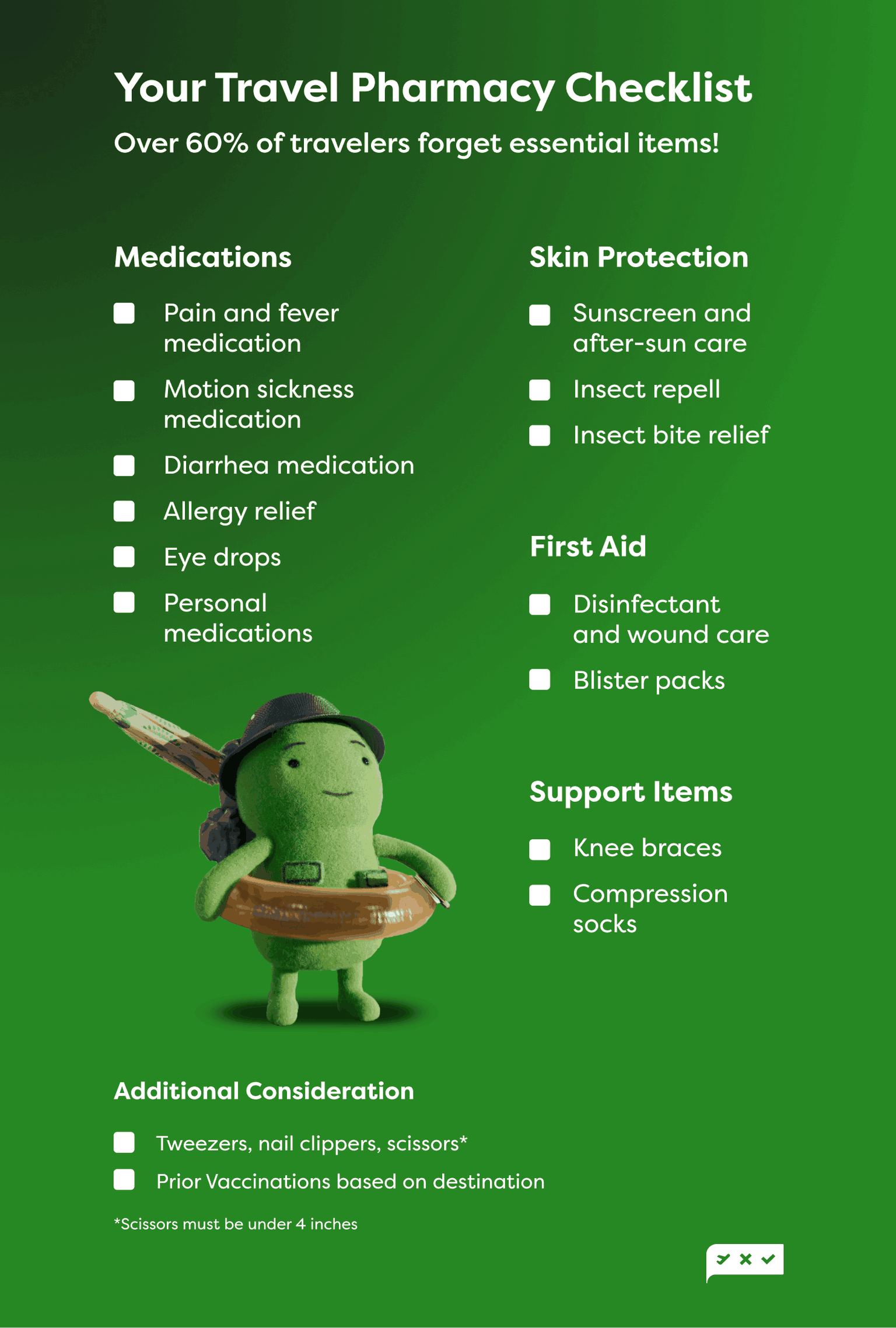
It is advisable to personalise your first-aid kit depending on the destination, duration of the trip, personal health needs and planned activities. Professional advice from a pharmacy can help you put together the perfect first-aid kit.
Is medication allowed on the aircraft?
Yes, medication may be carried on the aircraft, both in hand baggage and in checked baggage. The most important rule for hand baggage is to always keep the medication in its original packaging to minimise misunderstandings or questions from security staff.
Also note that liquid medications are often exempt from the restrictions on liquids in carry-on baggage, but may require inspection by security officers. Proactively informing security officers that you are carrying liquid medication can make the process easier.
What medication is allowed on the aircraft?
In principle, you are allowed to take all medications with you in your hand baggage as well as in your checked baggage. However, there are some guidelines and regulations that should be observed:
Prescription medication: These may be carried in hand luggage if they are in their original packaging and there is a medical certificate confirming the necessity of these medications for the person travelling by air.
Non-prescription medication: These can also be transported in hand baggage or checked baggage. It is advisable to leave them in their original packaging to avoid delays at security checks.
Liquid medicines: Special regulations apply to liquid medicines. Although they are generally exempt from the restriction on liquids in hand baggage, they must be presented to security officials during security checks. A medical certificate can also be helpful here.
Sprays, cool packs and other medical aids: These may be carried as long as they are necessary for medical treatment during the flight and contain less than 100ml of liquid. A medical certificate may also be required here to prove the necessity.
What medication should you have?
A basic holiday first-aid kit should include painkillers and antipyretics, remedies for diarrhoea, personal medication, disinfectant for wounds, remedies for allergies and insect bites, sun and skin protection, after sun cream for sunburn and remedies for travel sickness. Tweezers and scissors are also useful aids for minor medical procedures.
It is important to adapt the composition of the first-aid kit to individual health needs, the destination, the duration of the trip and the planned activities. Professional advice from a pharmacy can provide valuable support to ensure that your holiday first-aid kit is optimally tailored to your needs.
Can you take medication with you in your suitcase?
When travelling, medicines can be carried in both suitcases and hand luggage, although it is particularly important to carry essential medicines in your hand luggage to ensure access in the event of loss of your main luggage.
Care should be taken with packaging that can react sensitively to changes in temperature and pressure; these should ideally be transported in hand luggage and not in the hold.
Can I take paracetamol on the plane?
Yes, taking paracetamol during the flight is permitted and can be helpful for headaches or other minor complaints.
Can I take ibuprofen on the aircraft?
Yes, ibuprofen can also be carried in your hand luggage. It is advisable to have it in your hand luggage in case you experience pain during the flight.
Travel first-aid kit for babies, toddlers and children
A first-aid kit is particularly important when travelling with children. Children fall ill more quickly and get injured more easily on adventures. A well-stocked first-aid kit is therefore essential. Needs vary depending on the age of the child, so you should adapt the first-aid kit accordingly.
Travel first-aid kit for babies
Special care and preparation is required for the youngest travellers. The following items should not be missing:
Fever and painkillers especially for babies, for example in the form of suppositories or juice.
Remedies for flatulence and indigestion, as babies often react sensitively.
Electrolyte solutions to prevent or treat dehydration, especially after diarrhoea.
Wound protection cream to prevent or treat nappy rash.
Digital clinical thermometer for quick and accurate temperature measurement.
Nasal aspirator and saline solution to clear blocked nasal passages.
First-aid kit for small children
Toddlers are curious and like to explore their surroundings, which can lead to minor accidents. Your first-aid kit should therefore contain
Plasters and sterile bandages for small abrasions or cuts.
Mosquito repellent especially for small children to prevent insect bites.
Sunscreen with a high sun protection factor, suitable for sensitive skin.
Remedies for fever and pain, adapted to the child’s weight and age.
Anti-diarrhoeal medication and electrolyte solutions to stabilise the fluid and electrolyte balance.
Cough syrup or nose drops, specially formulated for children.
First-aid kit for children
As the children get older, you can add further items to the travel first-aid kit:
Personal medication if the child needs regular medication.
Allergy medication if the child has known allergies.
Travel sickness medication if the child is prone to nausea.
Disinfectants and antiseptics for quick cleaning of minor wounds.
Insect repellent and after-sun lotion for extra protection during outdoor activities.
Regardless of the child’s age, it is advisable to consult a paediatrician before long trips or trips abroad. They can make specific recommendations based on the destination, the duration of the trip and the child’s individual health conditions.
Observe the airline’s regulations
Medication can normally be carried in hand luggage, but to be on the safe side, you should check the specific regulations of your airline before departure.
The airlines’ websites provide information about the quantity and the way in which medicines must be packed and declared. Clarifying this in advance will help to avoid delays or problems at the security checkpoint.
Observe the regulations of the destination country
If you are planning a trip, especially abroad, it is crucial to find out about the health regulations and entry requirements of the destination country in advance. Each country has specific requirements and regulations that travellers must comply with in order to ensure safe and trouble-free entry.
Initiate the necessary vaccination programme in good time
Before you set off on a trip, especially when travelling long distances, it is important to check the necessary vaccinations and to take care of any special vaccinations in good time. Depending on your destination, the following vaccinations may be advisable or even mandatory:
Malaria
yellow fever
rabies
cholera
Japanese encephalitis
typhoid fever
Hepatitis A
Hepatitis B
Consult your GP to create a personalised vaccination schedule based on your destination, the nature of your trip and your personal health status. It is important to seek this advice early as some vaccinations need to be administered in several doses and take time to provide full protection.
The most important points to consider when packing your first-aid kit
The exact composition of the emergency kit for travelling depends on the type of trip (e.g. trekking tour, diving or beach holiday), the destination, the duration of the stay and the medical care in the holiday destination. However, some basic considerations should not be ignored:
Personal health needs: Consider your personal health needs and those of your fellow travellers. People with chronic illnesses should carry sufficient medication for the entire duration of their trip.
Destination: Find out about the health risks and availability of medical care at your destination.
Activities: The type of activities planned will also influence the composition of your first-aid kit. For outdoor activities such as hiking or diving, specific first aid items should not be missing.
Hygiene and protection items: In addition to medication, you should also pack insect repellent, sunscreen, after-sun lotion in case of sunburn and hand sanitiser.
Tips for travelling with medication
Travelling with medication requires careful planning to ensure that you are well looked after during your trip and that there are no problems at border crossings or security checks.
Here is a summary of the most important points:
Leave medication in its original packaging: This makes identification easier and minimises questions at security checks.
Carry a medical certificate: A certificate may be required upon entry or at the security checkpoint, especially for prescription and controlled substances.
Check storage requirements: Some medications require special storage conditions, such as refrigeration. Make sure you can take the necessary precautions.
Observe quantity restrictions: Carry only the amount of medication you expect to need to avoid questions or problems when importing.
Find out about medical care at your destination: Find out in advance about pharmacies and medical facilities near where you are staying, especially if you are travelling to remote areas.
Conclusion on the topic of first-aid kit checklist
To summarise, a carefully compiled first-aid kit is an indispensable part of any travel preparation. It not only ensures the supply of important medication in the event of minor health complaints or injuries, but also provides essential security in order to be able to react to unforeseen situations during the holiday. Taking individual health needs into account, adhering to transport guidelines for medication and adapting the pharmacy to the respective destination and planned activities are decisive factors for a carefree and healthy trip. Ultimately, a well-thought-out travel pharmacy is an expression of foresight and care that helps to maximise enjoyment and well-being when travelling.
How can Flightright help you?
You are stuck at the airport because of a flight delay? Your flight has been canceled, or you have been removed from the passenger list? In each of the situations described, you have a right to compensation as an air passenger.
Tip: Flightright helps you enforce your air passenger rights! With us, you can check your claims free of charge in two minutes. ✔️Easy, ✔️fast & without ✔️risk
According to the EU Passenger Rights Regulation, passengers are entitled to compensation in the event of a delay, cancellation, overbooking, or missed connection. You can claim up to 600 euros of compensation per person (minus commission fee). This compensation is independent of the ticket price. Flightright enforces your right for you. If necessary also in court.
As experts on the subject of air passenger rights, we enforce your right to compensation against the airline! Flightright’s air passenger rights experts are also happy to help you with ticket reimbursements