Let's be honest: airplane food isn't exactly known for being high cuisine, and it's often overpriced too. So it's no surprise that more and more travellers choose to bring homemade food, snacks, or even drinks with them when they fly. But before you even board the plane, you'll need to get through airport security first. In this article, we cover everything you need to know about bringing food through airport security and onto the plane.
Can you take food through airport security?
Yes and no — it depends on the type of food. In general, under the UK aviation security rules set by the CAA, there's no problem bringing dry food in your hand luggage or backpack through security. From homemade sandwiches to biscuits, nuts, fruit, and sweets, if it's packed properly, you can take it with you.
Liquid and semi-liquid foods, however, are a different story. A jar of jam, a pot of yoghurt, or your favourite energy drink all count as liquids, and must be stored in a transparent, resealable bag. Each container can hold a maximum of 100 ml, and the total liquid you carry must not exceed 1 litre.
Can you take alcohol through airport security?
Yes — with a few rules depending on where you're packing it.
In your hand luggage, alcohol is treated like any other liquid: it must be in containers of 100 ml or less, all fitting inside a single 1-litre resealable bag (the "100-1-1" rule: 100 ml per container, 1 bag, 1 litre maximum). This applies regardless of the drink's strength, so a full-size bottle of wine or spirits won't get through security in your carry-on — unless it's bought airside after security in a sealed, tamper-evident duty-free bag.
In checked (hold) luggage, it's based on strength rather than volume, per the CAA's official rules:
Up to 24% ABV (most wines, sparkling wine, beer) — no specific restriction
24–70% ABV (vodka, rum, whisky, gin) — allowed, but must be in original retail packaging and capped at 5 litres per person
Over 70% ABV — not allowed at all, checked or carry-on, as it's classed as a fire hazard
So a properly packed bottle of wine or sparkling wine travels easily in your suitcase, while spirits like vodka or rum are still allowed in checked luggage, just within the 5-litre limit. Exact allowances can vary slightly by airline and country, so it's worth double-checking before you fly with a large quantity of alcohol.
Can you take homemade food through airport security?
As with other snacks, solid and dry homemade food can go through security without any problems, as long as it's packaged properly. What matters most is the consistency of the food. Soups and stews count as liquids and are treated the same as any other liquid — so you may want to skip packing a hot, homemade soup for your journey.
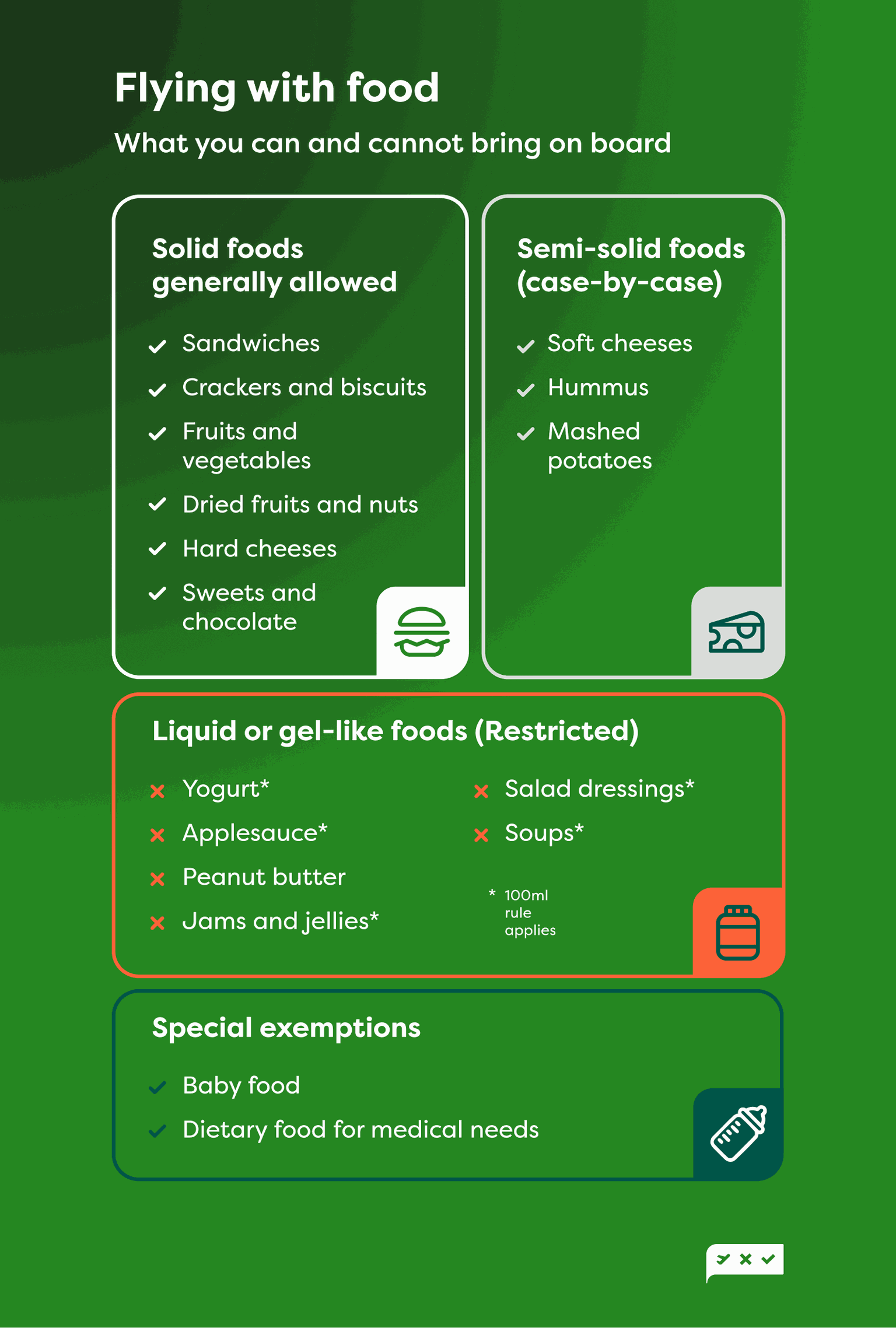
What food can you take through airport security
Permitted food
Sandwiches and wraps (wrapped in transparent film or stored in a box)
Bread and rolls
Chewing gum
Fruits and vegetables
Crisps, biscuits and other sweets such as chocolate bars
Tea bags and instant drinks
Homemade foods without liquid sauces or dips
Prohibited foods
Jelly-like spreads such as jam, chocolate spreads, honey, peanut butter, dips, ketchup, etc.
Sauces, dressings and dips
High-proof alcohol (see above)
Soups
Frequently asked questions about taking food through airport security
After airport security: Can you bring food on a plane?
Once you're through security, many people wander through the shopping halls and food courts. From shop-bought sandwiches to bottles of wine and duty-free chocolate, the choice is endless — so it's no surprise many travellers stock up before boarding. But does having more food in your bag change anything? Not really.
The answer is simple: yes, you can bring food on a plane.
How much food can I take on the plane?
In general, there's no fixed limit on how much solid food you can bring on board, as long as it's for personal consumption and not intended for resale. Some categories — such as baby food or specialist medical foods — may have their own guidance (for example, some airlines mention limits of up to 10 kg for these categories), so it's worth checking your airport's or airline's website in advance if you're travelling with larger quantities.
Good to know
Duty-free liquids and alcohol bought airside are packed by staff into a sealed, tamper-evident bag. This exempts them from the 100 ml rule for that flight, but the bag must stay sealed until you reach your final destination — it shouldn't be opened for consumption during the flight, and if you have a connecting flight, it may need to be re-screened. Any specific duty-free allowances (how many litres of spirits or wine you can bring in without paying duty) depend on where you're travelling to and from, so check your destination's customs guidance before buying in bulk.
Which foods are prohibited on airplanes?
If you're travelling within the UK and/or EU, you're generally allowed to carry meat, dairy, and plant products in your hand luggage, provided they're for your own consumption rather than commercial resale.
When travelling to or from a destination outside the EU, always check the import rules of your destination country first. Many countries strictly limit or ban fresh meat, dairy, fruit, and plant products at customs, and non-compliant items can be confiscated on arrival — sometimes with a fine attached.
Is water allowed on the plane?
Yes, but only under the standard liquid rules. Water in containers of 100 ml or less can go through security, as long as it's packed in a transparent, resealable bag of up to 1 litre. Typically, one such bag is permitted per passenger.
Rules can vary slightly by airline and country, so it's a good idea to check the specific guidance for your departure airport if you're unsure.
Can I take empty bottles onto the aircraft?
Yes. Airport security rules on liquids apply to full containers, not empty ones, so an empty, reusable bottle is generally fine to bring through the checkpoint. Security staff may still check that it's genuinely empty, since empty containers can occasionally be used to conceal other items. Once you're through security, you can refill it at a water fountain or refill station before boarding. As always, it's worth checking your specific airport's guidance, since practices can vary slightly.
What if I need to take food for my baby or medication with me?
Food for children is treated differently on a plane — especially baby food. If you're travelling with a child up to two years old, most airlines allow you to bring the food and formula your baby needs, in the quantity required for the journey.
Even so, baby food and formula must be declared to security, so keep it easily accessible — expect it to be tested or inspected separately. Don't bring more than you reasonably need for the trip.
The same applies to medication and specialist medical foods: these are generally exempt from the standard 100 ml liquid rule, but should be declared and may require supporting documentation (such as a prescription) and additional screening.
Airport food: Know the rules and regulations!
Many people don't think twice about packing food and drink for a flight, but airport security has strict rules, and it's worth knowing them before you travel. Some foods must be stored a certain way, and others are restricted altogether. Here is a quick recap:
Pack your food in airtight, see-through containers.
Observe the liquid limit: up to 100 ml per container, 1 litre in total.
Baby food and medicine are treated separately — check the current guidance in advance.
Know the rules for your specific route, especially if you're flying outside the EU or UK.
If in doubt, it's easier to eat the item before security than risk having it confiscated.
These rules might feel inconvenient, but they exist for passenger safety. Knowing them in advance means less risk of your food being thrown away, and a smoother, more relaxed start to your trip.
Delayed flight due to long security checks?
Long security queues can eat into your time at the airport, and packing your bags incorrectly can add unnecessary delays that risk you missing your flight. Since airlines aren't legally responsible for security wait times, you can't automatically claim compensation for a missed flight caused by queues. However, depending on your situation, you may still have options for rebooking or support.
Did you miss your flight because of an issue with security or your airline? Use our free claim check now to see if you are eligible to claim compensation.
How can we help you?
Everything is fine with your hand luggage, but the airline is standing in the way of your holiday happiness. Your flight is overbooked, delayed or cancelled? Has your baggage been delayed or lost?
Tip: Flightright can help you enforce your passenger rights! You can check your claims with us free of charge.
As experts in the field of air passenger rights, we enforce your right to compensation against the airline!