For sports enthusiasts, the idea of skipping out on their favorite activities during a holiday can be quite disheartening. A vacation without sports? It can quickly become dull, especially if keeping active is a big part of your lifestyle. So, how can you easily take your sports equipment along on the plane? Let’s explore.
Planning makes perfect
Thorough preparation is key, especially when it comes to jet-setting with your sports gear. In this article, we’ll share handy tips to ensure your equipment boards the plane as smoothly as you do. From selecting the right travel gear to navigating the nuances of airline guidelines, we’ve got you covered. With these insights, you’ll be ready to tackle your next sporting adventure with ease and precision.
Can you bring sports equipment on a plane?
Yes, you can generally take sports equipment on a plane. However, it’s important to follow the specific regulations of the airline you’re flying with, as these can differ. Preparing thoroughly is especially crucial if your equipment is bulky.
Safety and Protection
Ensuring the safety of your equipment during the flight is essential. Turbulence and movement can cause damage, so it’s advisable to use stable and secure packaging specifically designed for transporting sports gear. Such packaging not only protects your equipment but also makes the logistics process easier for airport staff.
Properly packed equipment ensures a smoother transport process and significantly reduces the risk of damage.
Sports equipment: standard baggage or special baggage?
For sports enthusiasts who don’t want to do without their favorite equipment when they’re on the road, a tricky question often arises: How do you transport unusual sports equipment that deviates from the norm? Special boards and rackets often do not fit into the classic suitcase and therefore require a place as special luggage. Whether it’s their impressive size or unusual shape, these sports equipment items require special handling when traveling. But don’t worry, airlines are prepared for such situations.
Dimensions and weight – How big can sports luggage be?
The classification of sports equipment as special baggage is mainly determined by its size and weight. The more unusual and bulkier the gear, the more likely it will need to be checked in and stored in the aircraft’s hold. For instance, a medium-sized badminton racket is often fine as additional hand baggage with many airlines. No extra declaration is usually required, making online check-in a breeze.
However, surfboards or baseball bats are a different story. These items are typically not allowed in the cabin due to their size and the potential danger they could pose as weapons. As a result, they must be checked in as baggage.
When it comes to the size and weight of your luggage, most airlines have similar guidelines. Typically, the maximum length allowed is around 9.84 ft, and the permissible weight ranges from 44 lbs to 70.5 lbs.
Most airlines have similar limits for the length, width, and height of baggage. Here’s a quick overview of how different sports equipment fares:
Sport | Relevant Equipment | Check-in required? |
|---|---|---|
Badminton | Badminton racket | no |
Baseball | Baseball bat | yes |
Basketball | Basketball* | no |
Archery | Bow and arrow | yes |
Cricket | Cricket bat | no |
Equestrian | Riding equipment | yes |
Fencing | Foil | yes |
Football | Football* | no |
Golf | Golf clubs | yes |
Hockey | Hockey stick | yes |
Inline-Skating | Inline skates | no |
Kayaking | Kayak | yes |
Lacrosse | Lacrosse stick | yes |
Running | Sport shoes/clothing | no |
Cycling | Bicycle | yes |
Horse Riding | Riding equipment | yes |
Shooting sport | Sport rifle | yes |
Swimming | Swimming goggles, fins | no |
Sailing | Sailing equipment | yes |
Skiing | Skis, Ski poles | yes |
Snowboarding | Snowboard | yes |
Surfing | Surfboard | yes |
Diving | Oxygen tank | yes |
Tennis | Tennis racket | no |
Table tennis | Table tennis racket | no |
Gymnastics | Gymnastics suit | no |
Volleyball | Volleyball* | no |
Windsurfing | Windsurfing board | yes |
*deflated
Bear in mind that regulations for carrying sports equipment can vary from one airline to another. If your gear doesn’t exceed the standard free baggage allowance of around 50.7 lbs, it’s usually carried with the rest of your luggage without any issues.
However, special rules apply for heavier items like bicycles, golf clubs, and ski or snowboard equipment. Fees for these items can depend on their weight, dimensions, flight route, and your travel class.
Checklist for taking sports equipment on the plane
Good preparation is like warming up before the game: essential. The following checklist is intended to provide an overview and ensure that all the necessary steps have been taken to transport special baggage without any problems.
Before booking
Find out about the general conditions for the transportation of sports equipment. Make sure to register your sports gear well in advance – preferably 24 hours before departure. Keep in mind that even with timely registration, transportation isn’t always guaranteed due to cargo hold availability.
If your journey involves multiple airlines, be aware that each airline’s costs and conditions will apply separately.
It’s a good idea to check with your travel agent or directly with the airline to see if there are special offers for sports travelers. These deals can not only save you money but also help ensure that your sports baggage arrives safely at your destination.
Costs and fees (from 40$)
When it comes to flying with sports equipment, most questions usually concern the costs, registration formalities, and transportation conditions based on the specific airline and travel class. Here are a few key points to consider:
Variable Costs: Fees can fluctuate depending on the airline, travel route (origin and destination), and your travel class.
Flat Rates: Many airlines charge flat rates for sports equipment, in addition to regular luggage fees.
Advance Registration Advantages: Registering your sports gear ahead of time often results in cost savings.
Free Allowances: Some airlines, like Lufthansa and British Airways, allow you to include sports equipment as part of the baggage allowance, typically one piece per person, free of charge.
Tip: Booking online in advance is usually more economical than paying at the check-in counter. Also, premium classes often come with a higher baggage allowance compared to Economy Class. As a final note, smaller sports equipment can often be carried as hand baggage without any extra cost.
Specific equipment guidelines
Golf clubs (golf luggage) and umbrellas
Usually included in the free baggage allowance and free of charge, provided the weight is not exceeded
Prior registration is generally required.
The typical weight limit for golf equipment, including clubs, shoes and other accessories, is 50 lbs (including hard case).
Transportation in a sturdy hard case is recommended and is mandatory for some airlines.
Airline | Transport policies |
|---|---|
Included in the standard baggage allowance with a maximum of 50 lbs – learn more | |
Included in the standard baggage allowance with a maximum of 50 lbs including golf umbrella – learn more | |
Additional fee with a maximum weight of 50 lbs. Limit is one piece of baggage per person – learn more | |
Additional fee as per the above-mentioned conditions – learn more | |
Additional fee with a maximum length of 7.2 ft . Pack golf equipment in one piece of baggage – learn more | |
Additional fee with a maximum weight of 44 lbs. Limit is one piece of baggage per person – learn more | |
Included in the standard baggage allowance when carried in hard case with a maximum of 50 lbs – learn more |
Flying with a bike – How big can it be?
Bicycles can be transported, but usually for a fee. Consider these costs when planning your trip.
Pre-registration of your bicycle with the airline is required to avoid issues at check-in.
E-bikes are mostly excluded, except where the battery can be removed according to regulations to ensure safety.
The best way to transport your bicycle is in a bike box (always accepted). Label the box with your contact information to quickly resolve any issues in case of loss or damage.
Thoroughly dismantle the bike: remove the pedals, align the handlebars parallel to the frame, and take off the tires to prevent damage and facilitate transport.
Airline | Transport policies |
|---|---|
Registration is required 48 hours before departure. Up to 50 lbs. Price varies depending on the flight route. E-bikes allowed without battery – learn more | |
Included in the standard baggage allowance up to 50 lbs and 6.2 x 3.1 x 2.1 ft, otherwise (additional) fees. No E-bikes allowed – learn more | |
Additional fee and maximum 70.5 lbs. Limit is 1 bicycle per person. No E-bikes allowed – learn more | |
Additional fee as mentioned above. No E-bikes allowed. 1 bicycle per person – learn more | |
Additional fee with a maximum size of 9.18 ft (H/W/D). No E-bikes allowed. 1 bicycle per person – learn more | |
Additional fee and maximum 66.1 lbs. No E-bikes allowed. 1 bicycle per person – learn more | |
Additional fee. No E-bikes allowed. Oversized fees are waived if properly packed. – learn more |
Diving equipment
Standard Baggage: Diving equipment (mask, fins, suit, etc.) can be included in the free baggage allowance.
Oxygen Tanks: Must be transported separately and may incur additional fees. They must always be empty, the valve open, and properly marked. Prior registration is required.
Lamps and Electronics: Wherever possible, transport lamps and other electronic devices without batteries. Batteries and accumulators can then be carried separately in hand luggage. Prior notification is generally required.
Knives and Harpoons: Different regulations may apply.
Airline | Transport policies |
|---|---|
Included in the standard baggage allowance with a maximum of 50 lbs. Oxygen tanks cost extra – learn more | |
Included in the standard baggage allowance with a maximum of 50 lbs – learn more | |
Additional fee and a maximum of 44 lbs as extra checked baggage – learn more | |
Additional fee as per the mentioned conditions. Maximum weight 70.5 lbs – learn more | |
Additional fee with a maximum size of 6.6 ft (L/W/H) – learn more | |
Additional fee and a maximum of 44 lbs. Limit is 1 piece of baggage per person – learn more | |
Additional fee for scuba tank from 150$. Other equipment is included in checked bag allowance. – learn more |
Ski equipment and snowboard
Many airlines count skis, poles and ski boots as one piece of luggage if they are packed together. Clarify this with the airline before you travel.
Skis and snowboards should be packed in special bags or cases to protect the edges and secure the equipment.
Early registration is advisable, as fees can vary and advance registration saves costs.
Many airlines count skis, poles and ski boots as one piece of luggage if they are packed together. Clarify this with the airline before you travel.
Airline | Transport policies |
|---|---|
Included in the standard baggage allowance with a maximum of 50 lbs and 9.84 ft. 1 ski boot bag and 1 ski/snowboard bag count together as 1 piece of luggage – learn more | |
Included in the standard baggage allowance with a maximum of 50 lbs and 6.2 x 2.5 x 2.1 ft – learn more | |
Additional fee and a maximum of 44 lbs. Limit is 1 piece of baggage per person – learn more | |
Additional fee as per the aforementioned conditions. 1 piece of baggage for skis or snowboard plus 1 piece of baggage for shoes, helmet, and suit. Maximum weight 70.5 lbs – learn more | |
Free in addition to the free baggage allowance with a maximum length of 6.6 ft. Winter sports gear can be packed in 2 separate pieces: 1 piece with a pair of skis OR a snowboard. 1 piece with a pair of poles and a pair of ski OR snowboard boots. 1 helmet – learn more | |
Additional fee and a maximum of 44 lbs. Limit is 1 piece of baggage per person – learn more | |
Included in the standard baggage allowance with a maximum of 50 lbs – learn more |
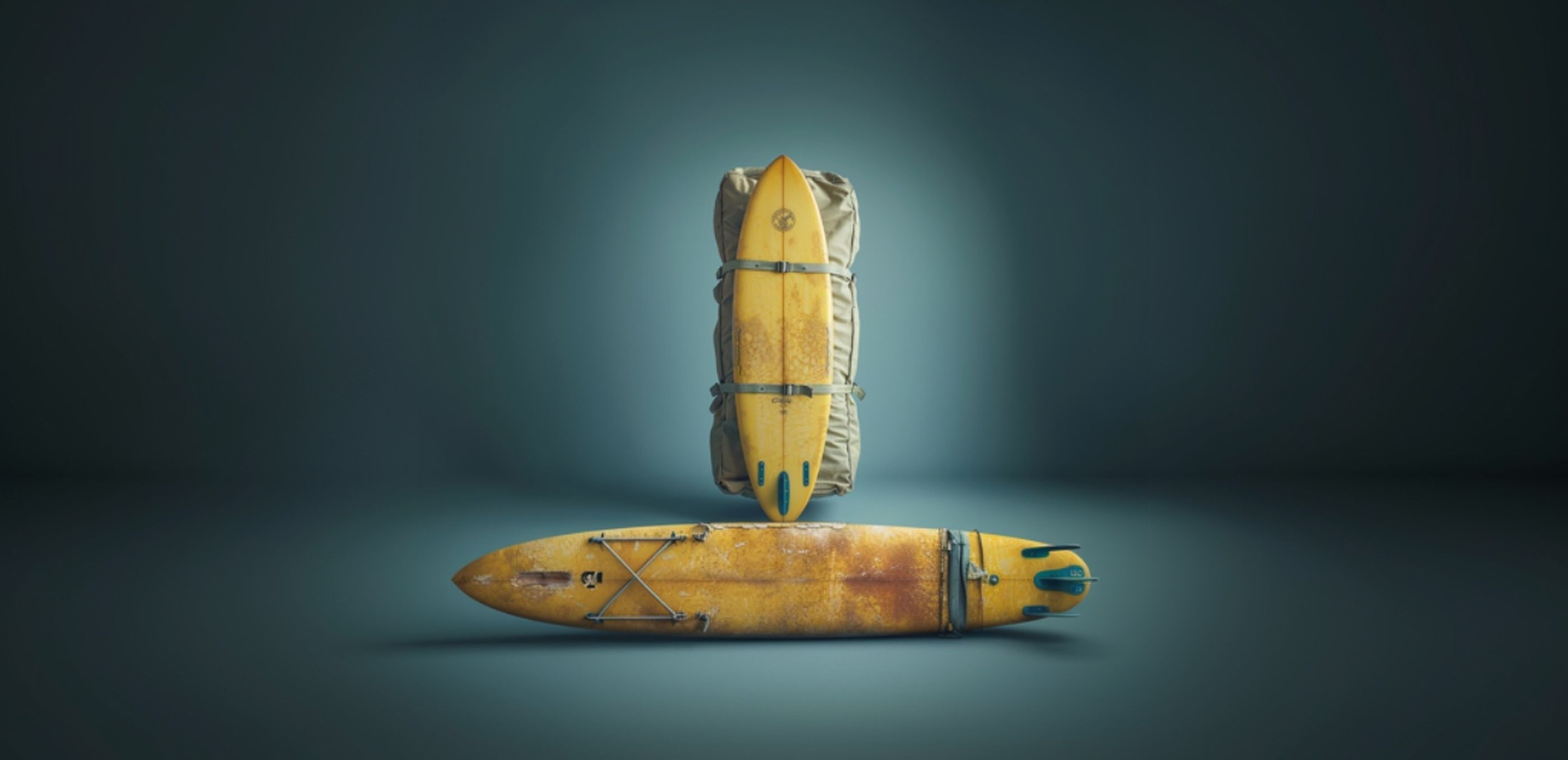
Flying with surfboard and kitesurfing equipment
Most airlines allow surfboards and kitesurf boards as bulky baggage, often for an additional charge.
Fees vary greatly, from free to over 100$ per route.
Maximum dimensions and weights for bulky baggage vary depending on the airline.
Prior registration of bulky baggage is usually required.
Special board bags or covers offer additional protection.
It is recommended to pad the board with bubble wrap or towels and remove the fins.
Airline | Transport policies |
|---|---|
Included in the standard baggage allowance with a max of 50 lbs and 3.5 ft. If larger up to a max of 9.84 ft, then an additional fee applies – learn more | |
Included in the standard baggage allowance with a max of 50.7 lbs and 6.2 ft. Anything beyond incurs an additional fee – learn more | |
Additional fee and max 70.5 lbs. Limit is one board per person – learn more | |
Additional fee as per the above conditions. One piece of baggage for board/board plus one piece of baggage for suit – learn more | |
Additional fee with a maximum length of 10.3 ft – learn more | |
Additional fee and max 44 lbs. Limit is 1 piece of baggage per person – learn more | |
Allowed with specific regulations – learn more |
Sport shooting equipment (firearms)
Carrying sporting rifles on flights is subject to strict airline rules and regulations. Here are the most important points:
Early registration of up to 72 hours before the flight is often required, typically via the service hotline.
Additional documents may be necessary.
Rifles must be unloaded, packed in a sturdy, locked hard-shell case, and declared as sports baggage.
Rifles and ammunition can be transported in the same baggage but need to be packed in separate compartments within the same bag.
Rifles and ammunition must not be transported in baggage that contains other personal items.
Cartridges must remain in their original packaging, and all empty spaces should be filled with padding to prevent movement during the flight.
Airline | Transport policies |
|---|---|
Additional fee – learn more | |
Additional fee – learn more | |
Additional fee – learn more | |
Additional fee – learn more | |
Additional fee – learn more | |
Not allowed – learn more | |
Additional fee – learn more |
Registration and confirmation of sports baggage
Registering your sports equipment is essential to ensure it’s accepted and transported by the airline. The registration process may vary depending on the type of equipment and can typically be managed online or through the airline’s customer service. Sometimes, you might need to provide technical details or specific documentation.
Reserve your bulky or special baggage at least 24 hours before departure. This can be done at the time of booking or later, but make sure that the reservation is confirmed and approved before you travel. This confirmation acts as proof that your sports equipment is authorized for the flight.
Proper Packing of Sports Equipment
Transporting your sports equipment safely starts with proper packing. The fees and registration are important factors, but ensuring that each piece is securely packed is even more crucial.
Using specialized packaging materials helps protect sensitive items like boards and rackets from potential damage during the flight. This not only safeguards your equipment but also facilitates smooth logistics and supports overall flight safety.
Guidelines and Tips for Packing and Transporting Sports Gear
Follow Airline Instructions: Adhere to the packing guidelines provided by your airline; they often include useful tips.
Use Suitable Containers: Opt for hard-shell cases or other robust containers.
Interior Padding: Carefully pad the interior to protect your gear from movement and potential damage.
Weight Limits: Be aware of any maximum weight restrictions for sports equipment set by your airline.
Bulky Baggage Counter: All relevant sports gear should be handed in at the bulky baggage counter, usually located near the check-in desks.
Take time to understand the dimensions and weight restrictions of your baggage as per the airline’s guidelines. Proper packing is not only vital for the safety of your equipment but also helps in avoiding additional costs due to excess baggage.
Space constraints or specific regulations may prevent certain items from being transported. For example, sharp objects like martial arts swords are always treated as checked baggage.
Weight and size restrictions are in place not only for safety and stability during the flight but also to avoid delays and congestion during boarding.
Handling at the airport
On the day of your departure, it’s critical to allocate ample time for check-in. When you arrive at the airport, make sure to inform the staff that you have sports baggage. Typically, you’ll be directed to a specialized counter or area to prepare your equipment for transportation.
Your sports gear may undergo additional security checks. These checks are standard safety procedures and are similar to regular airport security measures. You might need to open your bags or provide details about your sports equipment. Staying cooperative and patient will make the process smoother.
Some items, like skis and snowboards, may have designated drop-off points. Remember, there could be extra charges if your equipment is considered bulky or exceeds the standard baggage weight limits.
After handing over your sports baggage, you’ll receive a transportation confirmation. Keep this document safe, as you’ll need it later.
At the destination Airport
Upon arrival at your destination, head straight to the baggage reclaim area to collect your sports equipment. If there are any delays, or if your baggage is damaged or lost, report this immediately at the airline’s counter. Make sure to have your transportation confirmation and all travel documents handy. The airline is responsible for addressing any claims for damage or loss and will guide you through the next steps.
Have you faced a flight delay in the past three years?
Possible pitfalls
Travelling with special baggage can come with its challenges. Here are some common pitfalls to be aware of:
Compliance Issues: The airline may refuse to accept your special baggage if it does not meet specific packing guidelines. Safety is always the top priority, so make sure you follow the rules to the letter.
Limited Storage: Occasionally, there may be no available storage space for additional or special baggage, especially if it was registered at short notice or on the day of travel.
Cabin Baggage Restrictions: Sometimes sports baggage that would normally be allowed in the cabin must be checked in due to a lack of space. If not adequately padded, this can increase the risk of damage.
Lack of Packaging Materials: Another common issue is the unavailability of packaging materials for last-minute packing or re-packing.
Anticipating these potential issues and preparing accordingly can help ensure a smoother travel experience with your sports equipment.
Alternatives to air transportation
Transporting sports equipment by air often comes with limitations regarding size, weight, and cost. Fortunately, there are alternative methods that offer various advantages:
Courier Services: These services can provide quicker and more reliable transportation, particularly for door-to-door delivery. This is especially beneficial for bulky or heavy sports equipment, as it reduces the risk of loss or damage.
Freight Shipping: While this option is often more economical, especially over long distances, it usually involves longer delivery times and possibly more complex collection processes.
Before choosing one of these alternatives, carefully weigh the pros and cons. Consider what matters most to you—speed, cost control, or convenience—to make the best decision.
Considering Rental Options
Sometimes, travelling without your sports equipment might be a smart choice. Many popular sports and leisure destinations are equipped with rental stations offering a wide range of well-maintained gear. This can streamline your travel plans and eliminate worries about potential damage or loss in transit.
One of the perks of renting is access to modern, state-of-the-art equipment, especially important in sports where technology plays a big role, like skiing or golf. Opting for rental gear can also be cost-effective by saving you from additional baggage fees and transportation costs.
When choosing to rent, ensure the quality and condition of the equipment. Checking reviews and getting recommendations from fellow travelers can be very helpful.
Summary for a Stress-Free Journey with Sports Equipment
To ensure a smooth trip with your sports gear, keep these key tips in mind:
Plan and Organize: Thorough planning and organization are essential.
Early Applications: Complete the application process well in advance to secure all necessary confirmations.
Check Airline Rules: Review the transportation conditions specific to your airline and pack your equipment according to their guidelines.
Adhere to Limits: Follow weight and size specifications to avoid extra baggage fees.
Additionally, create a detailed inventory of your sports gear and keep it in your hand luggage as proof in case your baggage is lost. Consider purchasing insurance to cover any potential damage. With these steps, you can look forward to a hassle-free start to your sporting adventure.
How can Flightright help you?
Are you stuck at the airport due to a flight delay? Your flight has been canceled or you have been removed from the passenger list (denied boarding)?
According to the EU Passenger Rights Regulation, passengers are entitled to compensation in the event of a delay, cancellation, overbooking, or missed connection. You can claim up to 600 Euros (~ 640$) of compensation per person (minus commission fee). This compensation is independent of the ticket price. Flightright enforces your right for you. If necessary also in court.
Tip: Flightright helps you to enforce your passenger rights! With us, you can check your claims free of charge in two minutes. ✔️Easy, ✔️fast ✔️& without risk
As the market-leading consumer portal, Flightright fights for the enforcement of air passenger rights. We stand up for your rights in the event of a flight delay, cancellation or denied boarding and refer to the European Union’s Air Passenger Rights Regulation 261/2004. Flightright’s air passenger rights experts are also happy to help you with ticket refunds and refunds for canceled package tours.
As experts in the field of air passenger rights, we enforce your right to compensation against the airline!